


By Nia Kajastie
During a recent trade press tour at Liebherr-Werk Telfs in Austria, where Liebherr manufactures its crawler dozers, the German-Swiss company shared updates on its earthmoving product segment. Another key topic was the latest developments in remote control and autonomous operation.
Liebherr is advancing digital, automated and networked technologies for construction and mining equipment. It is using intelligent software, AI-supported assistance and autonomy functions, as well as remote control systems, with the aim of making operations safer, more efficient and more economical.
Liebherr stresses that there is “no such thing as the optimum degree of automation.” The appropriate degree depends on the machine type, application and customer requirements. High or full automation is suitable for highly repetitive tasks, while on sites with complex, volatile environmental conditions, intelligent assistance or partial automation systems can better support operators with more creative tasks or solution-oriented work.
“We provide differentiated solutions for every application in order to offer our customers maximum benefit,” said Manuel Bös, head of emerging technologies at Liebherr-Werk Bischofshofen. “But they all have one thing in common: They are easy to use and don’t require IT experts.”

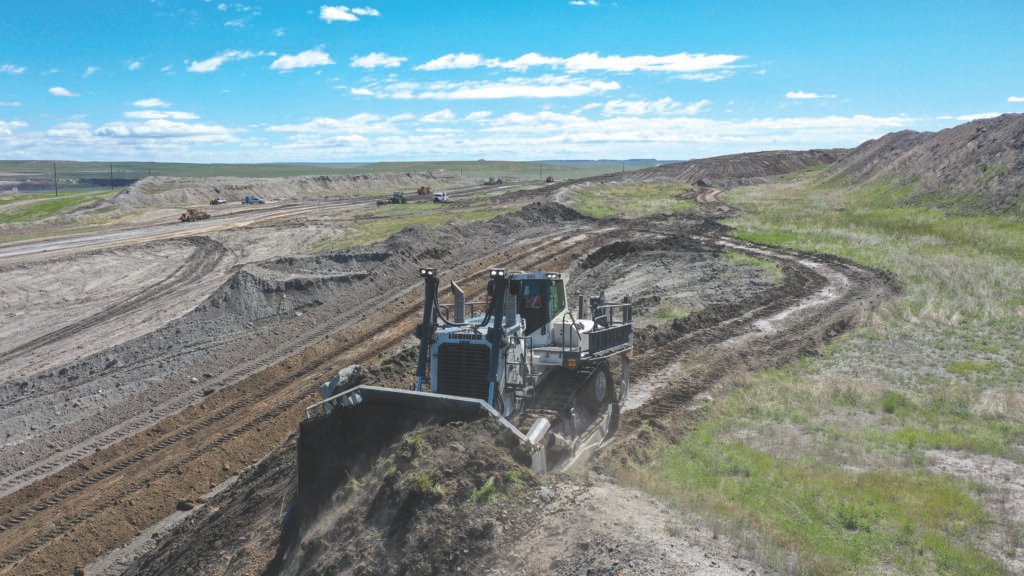
A PR 776 moves topsoil at the Belle Ayr mine in Wyoming, USA. (Photo: Liebherr)
Overall, Liebherr does not view autonomous machines as replacements for conventional equipment, but rather as complementary to them.
PR 776 G8 Dozers Operated With LiReCon
During the tour, Liebherr provided an update on its PR 776 Generation 8 dozer, which was originally launched at MINExpo 2024.
Since its debut, the PR 776 G8 has been deployed in mining and quarrying operations in Ghana, the USA, Canada, Australia and Spain.
The latest generation machine is equipped with electronic architecture suitable for “Liebherr Remote Control” (LiReCon) operations, as well as enabling further development for autonomous steps in the future.
By mid-2026, two PR 776 G8 dozers will be operating using the LiReCon teleoperations system in a mining application for the first time. Liebherr Mining will be deploying the system for SQM’s Nueva Victoria iodine and sodium nitrate mine in northern Chile.
The LiReCon solution consists of the Liebherr Remote Control teleoperation stand, which is a dedicated operator workspace with all necessary controls, and onboard dozer installations, including cameras providing multiple angles and views, microphones for recording machine sounds and a radio link receiver and transmitter.
LiReCon is designed for rapid shift changes between operators, reducing idle time and downtime. By freeing the operator from the machine, it also enables access to extraction areas in hazardous zones, expanding the range of applications for Liebherr mining dozers.
LiReCon is part of Liebherr Mining’s IoMine Automate technology product range.
The PR 776 G8 dozer also integrates advanced Operator Assistance Systems (OAS), previously available only on smaller models. Two additional packages are available for mining dozers: the Blade Control Assistance package, which provides automated blade control to improve performance and reduce operator fatigue, and the Ripper Control Assistance package, which automates repetitive ripper tasks to further reduce fatigue.
A new Load Control package, building on the existing systems, will be launched in 2026 for the PR 776 G8 mining dozer. This OAS package is designed to maximize traction, reduce track slip and maintain consistent performance across varying ground conditions.
For the PR 776, OAS can be installed as a first-fit option or retrofitted to machines already in operation.
Liebherr Assistance Systems for all mining equipment models are part of the IoMine technology portfolio.
“Mining customers in general are looking for reliability, productivity and safety. I think with our LiReCon system, we can deliver all these pillars,” said Markus Wittwer, head of sales, PR 776 and mining, at Liebherr-Werk Telfs.
“The technology, of course, is a milestone, but at the end of the day, I think the whole operation and the productivity of the system depends on the Operator Assistance Systems on the machine. This is key to success in the mining environment — and also in other environments. That’s why I see that for our LiReCon system in the mining world, we’re well prepared, because Assistance Systems are proven on small dozers for many years. Now we have it on the Generation 8 on the PR 776. It will be a good solution for miners and serve all these pillars.”

LiReCon, Liebherr’s teleoperation system for its Generation 8 dozers, improves the safety of dozing operations in especially hazardous areas on site. (Photo: Liebherr)
The Expanded IoMine Portfolio
Liebherr presented its updated and expanded technology portfolio, IoMine, at MINExpo 2024.
It comprises three product families: Operate, designed to optimize daily mining operations through data collection and analysis; Automate, for advanced automation solutions; and Maintain, digital services designed to increase machine uptime.
These cover technology products, such as Liebherr’s Autonomous Haulage Solution, Machine Guidance System, Fleet Management System and Remote Service.
The IoMine name refers to an “integrated operations approach to mining.”
“An integrated operations approach uses a connected ecosystem of technologies to optimize the load and haul cycle. Enhancing these processes improves both productivity and safety — two vital criteria for our customers,” explained Swann Blaise, general manager for marketing at Liebherr-Mining Equipment.
While Liebherr is focusing on developing IoMine for its own machines, it is also considering mine sites with mixed OEM fleets.
“We are open to integrating that on other machines from other OEMs, but this depends on how much access we can get to these machines, as each machine has its own system and architecture,” Blaise noted.
Liebherr is currently testing its fully autonomous solution for mining trucks at a Fortescue iron ore mine in Western Australia.
“It’s a co-development with the (mining) company, and we are currently in the validation phase,” explained Blaise. “This is a Tier 1 mining house, so really important, one of the big autonomous truck users. The goal at the end is to independently commercialize our own solution for the rest of the mining industry.”
The strategic collaboration ensures that the solution leverages the best experience from both the OEM and the customer.
The site’s solution combines the Fleet Management System and the Autonomous Haulage Solution, using the T 264 truck model, with a 240 metric ton (mt) capacity. The site will also host Liebherr’s largest mining truck fleet.
Autonomous Wheel Loader Trials
At bauma 2025 in April, Liebherr celebrated the “world premiere” of its autonomous wheel loader. Liebherr-Werk Bischofshofen, the site responsible for the Liebherr Group’s wheel loaders, is now continuing development of this autonomous solution.
At the core of the autonomous wheel loader is the “Liebherr Autonomous Operations” system.
Liebherr is currently trialing this technology with several test customers under real-world conditions. The test sites range from industrial environments and mixing plants to gravel pits and quarries. Data and experiences from these trials will be used to optimize the test machines.
The autonomous system is designed for use in hazardous areas, while simultaneously freeing up employees to focus on more complex activities.
“We are currently in the field with wheel loaders in various environments, and there are a lot of use cases where the monotonous part is quite a big part of the day; no one wants to do these jobs,” Bös said.
Liebherr has developed an “Autonomous Job Planner” web application, through which work orders can be easily defined in a 3D operating environment without any special IT knowledge.
By using 3D environmental sensors, the machine recognizes its surroundings, piles and obstacles. Additional aids such as drones or separate surveying technology are thus not needed. Based on this information, it plans each work cycle, executes it independently and adapts to changes in the environment and different bulk materials. The system does not rely on GPS, allowing it to operate in halls, underground, on high demolition walls or under vegetation.
“Right now, it cannot do everything,” Bös noted, “but it will evolve over time. So, just via a software update, we will unlock new use cases step by step. Today, it can do pile to hopper, pile to pile, but it cannot do snow clearing or something that is very strategic and very complex, which the human needs to do for many years to come.”
While Liebherr does not reveal its automation roadmap publicly, Bös stressed that this is not a wheel loader specific development.
“We can connect the LiReCon and autonomy package to different machines. In every type of machine there is this spectrum of use cases, from rather simple to very complex, so every product we’re looking at, we start with the simple one,” he said.
“It is scalable to everything that’s yellow.”

Operators start job planning for an automated wheel loader using the Autonomous Job Planner app. (Photo: Liebherr)
S1 Vision – The Future of Material Haulage?
During the recent trade press tour, Liebherr also presented its S1 Vision, which has been created as a rethink of the classic haul truck design. The focus is on the core components needed for moving material — namely a single axle and two tires. This autonomous vehicle aims to combine compactness with flexibility.
“In a world where we usually think about performance in terms of adding more — more size, more weight, more power, more cost — we looked at it the other way around. We said, what if we can subtract everything that’s unnecessary? And that’s where we ended up with the S1,” said Altan Enginalev, CEO of S1 Vision at Liebherr Group.
A key concern for Liebherr’s customers is the total cost of ownership for equipment.
“If we remove from the vehicle all the components that are not necessary, we have fewer components. When we remove things like steering and suspension, we remove failure points in the system,” he added.
“You remove stress points between two axles — the stress point is actually on one axle. We add capabilities for autonomy and remove costs of people. You remove costs of processes, going from a step process to an ongoing, continuous process, and that’s very exciting.”
The innovation was developed collaboratively by Liebherr Corporate Ventures — the group’s innovation and technology development unit — and Liebherr Mining Equipment Newport News Co, the group’s mining truck R&D and manufacturing facility.
The technology is now being advanced at group level to strengthen synergies and support innovation across multiple product segments.
With a payload range from 220 kilograms to 131 mt, it would be suitable for diverse applications across earthmoving, agriculture, construction and mining.
In order for the truck to operate on a single axle, the S1 Vision features a self-levelling system. This is meant to provide maximum stability and safety, even on bumpy or rough terrain, reducing the risk of tipping.
In addition, the S1 Vision’s zero-turn radius means the truck can turn on the spot and travel in all directions, making it suitable for applications in tight spaces.

The S1 Vision haulage concept is designed to focus on the core
components necessary for moving material. (Photo: Moodley)
The truck is powered by an electric drive, which helps reduce greenhouse gas emissions during operation. It is equipped with advanced sensors so it can navigate independently, avoid obstacles and manage traffic.
If multiple S1 Vision trucks were to operate in one location, the system would allow them to connect and share real-time data for optimization of fleet operations, reducing congestion and boosting efficiency.
Its advanced digital control system also offers future readiness by enabling seamless communication with other machines within a connected digital ecosystem.
However, the big question is: how far away is the S1 Vision from becoming a reality?
“What’s important is that the S1 Vision is not just a sketch or a vision board or an idea. We actually built it. It works, it balances, it drives and it’s real,” Enginalev stressed.
“The purpose is not to just showcase it (…), but to validate all the technical aspects of it: balancing the load, balancing energy systems, the controls, the algorithms, generally the physics around it. Now we know that it works, and it’s validated, the next step is to scale it.”
He added: “It takes strong partnership with specific industries, so we don’t just dream disconnected from reality, but we actually develop solutions that have application in the real world. We will not be able to tackle all industries at the same time, but where are the industries that are the most needing at this current point in time for an innovation or revolution like that?
“What’s really reassuring is that we’re talking to partners that also share the vision, so we can together move into the future.”
When one of the S1 Vision vehicles will be seen in operation depends on these partners and their specific
use cases.
Nia Kajastie is the European Editor for Coal Age’s sister publication, Engineering & Mining Journal (E&MJ).