

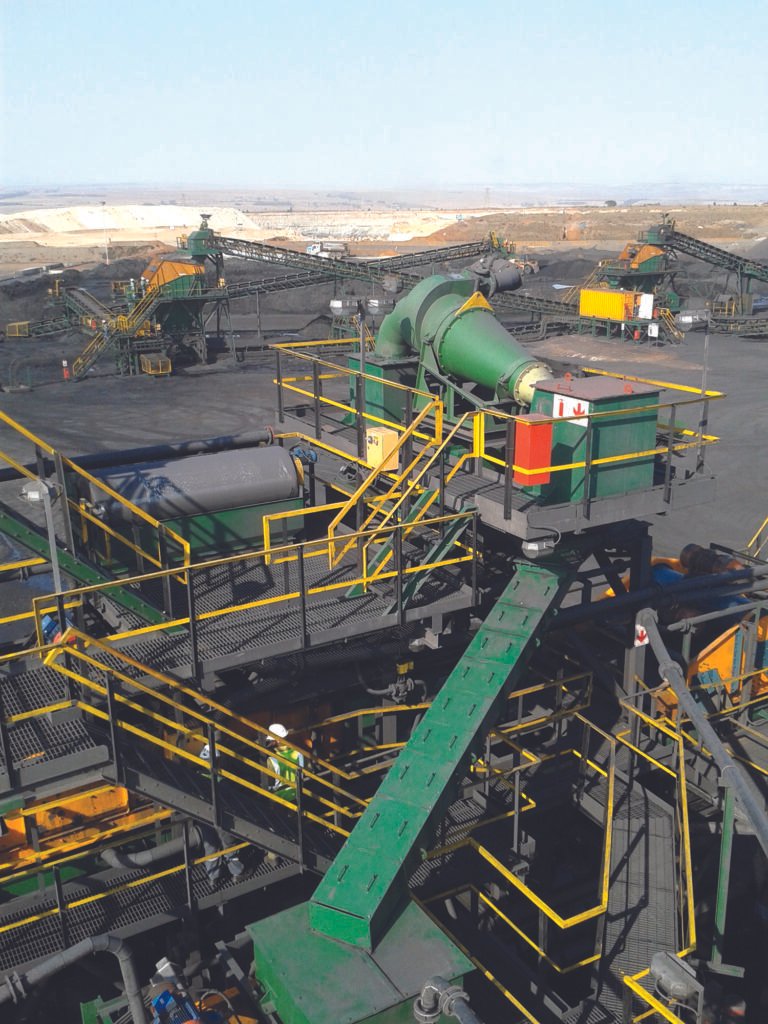


Multotec’s cyclone design innovations provide ultimate wear protection and maximum separation efficiency. (Photo: Multotec)
Customizable hydrocyclones require minimal space and maintenance, and deliver uptime and results over the longrun
By Jesse Morton, Technical Writer
The simple hydrocyclone can help answer three trending challenges for a plant, Multotec experts told Coal Age. In some regions and for some plants, these challenges are not definitive. At others, they are pronounced and dogged. For those operations, the hydrocyclone may be a game-changer.
First and foremost, mechanized mining is, in general, creating more fines and “more contamination with unwanted waste material,” said Frikkie Enslin, product manager, cyclones, Multotec.
Second, in “some locations in the world, the quality of coal being mined is declining due to the depletion of high-grade resources, leading to a re-evaluation of traditional processing strategies,” he said. “This also applies to operations where old existing coal dumps are being reprocessed.”
These two trends intersect with a third: increasing regulations on water usage. “Coal-handling and processing plants are under tremendous pressure to reduce freshwater usage and improve tailings dewatering and water recovery from within the process,” he said.
Based on a cone angled at about 15°, the main adjustable parts are an inlet at the top and a spigot at the bottom. Feed slurry is pumped into the top at an orientation and rate that creates a “strong vortex for centrifugal separation,” said Ernst Bekker, process specialist, cyclones, Multotec.
The vortex sends the heaviest particles outward and down the sides of the cone, then out the spigot. “Coarse or heavier particles experience a greater centrifugal force and are pushed toward the cyclone wall,” he said.
The fines ride the water up the eye of the vortex and then out with the overflow. “Due to drag forces, finer or lighter particles migrate toward the center of the cyclone, close to the vortex, where the pressure is lowest,” he said. “They are carried out the top of the hydrocyclone by the upward, inner spiral flow pattern exiting through the vortex finder, situated in the cyclone inlet head.” The overflow is “usually dilute, containing most of the water used to feed the material into the hydrocyclone and the fines.”
That basic design has been around for well over a century. The first hydrocyclone was patented in 1891.
Today’s “high-capacity and fine-coal hydrocyclones efficiently separate fine and ultra-fine particles down to 45 microns (μm),” Bekker said. They can be configured to recover a specific “size range for further beneficiation without contaminating the process with excessive ultra-fine material or by misplacing coarse material from the process, which leads to recovery losses.”
The design variables that can be configured “include cyclone diameter, inlet diameter and the cyclone length,” he said. The adjustable process variables “can include feed solids concentration, pressure and flow rate.
The top benefits of the hydrocyclone stem from its simplicity, efficiency and adaptability. “Some of the main features of hydrocyclones include the fact that they have a relatively simple design with no mechanical components, which reduces maintenance and downtime,” Bekker said. A hydrocyclone “contains no moving parts, which leads to lower capital and maintenance costs.”
The hydrocyclone is “simple to install and operate, with minimal maintenance needs and is ideal for modular or space-limited plants,” he said. “With proper operation, they can achieve a relatively high separation efficiency in a small footprint.”


Above, Multotec’s hydrocyclones are arranged clusters for high-throughput applications. (Photo: Multotec)
That capability can boost outcomes downstream. “Hydrocyclones have the potential to improve thickener performance by producing cleaner overflow to the thickener,” Bekker said. “Hydrocyclones can also assist the plant’s dense medium separation circuit’s efficiency by incorporating a densifying cyclone in the medium recovery circuit,” he said. “This process route applies to medium- to high-density separation circuits or where water removal from the process cannot be achieved with the existing process equipment.” Efficient separation circuits use less water and send fewer fines to be managed as tailings, helping a plant meet regulations.
Theoretically, hydrocyclones are more efficient and reliable than other separation solutions, like screens, spirals, classifiers and mechanical separators. “Other solutions have moving parts that wear, vibrate and require regular maintenance,” Bekker said. “Hydrocyclones have no moving parts. Only the slurry moves.”
Compared to other separation solutions, hydrocyclones have a smaller footprint and fewer infrastructure requirements. “Hydrocyclones require up to 70% of the footprint of equivalent mechanical systems,” he said.
In fact, where footprint is a key constraint, “hydrocyclones become the equipment of choice as the solids mass flowrate per square meter is much higher, compared to fine or ultra-fine screening,” Bekker said. “The hydrocyclone can accommodate a wide range of solids feed rates, which translates to volumetric flow rates, and thus feed mass flowrate fluctuations can be better accommodated with hydrocyclones,” he said. “On fine and ultra-fine screens, additional screen area, or larger panel apertures would normally be required to accommodate additional feed rates.”
Unlike some separation solutions, hydrocyclones can integrate into “smart plant operations with real-time performance management,” Bekker said. “Lastly, hydrocyclones are one of the lowest total cost per ton
separators available.”


With a small footprint, microcut classification hydrocyclones are designed for a specific cutpoint. (Photo: Minco Tech)
Cyclones With Top Capacity, Longevity
Multotec offers a range of hydrocyclones to multiple industries. “We are currently able to supply 16 different cyclone sizes, the smallest being 25 mm (1 in.) and the largest being 1.4 m (4.6 ft) in diameter,” Enslin said.
“These units have a volumetric capacity ranging between 0.2 m3/hr (0.87 gallons per minute, gpm) to 3,800 m3/hr (16,700 gpm) of slurry per unit, depending on the specific operating conditions,” he said. “Furthermore, we have eight different materials of construction combinations to cater to a variety of industries, processes and commodities.” Those materials include “mild steel, rubber-lined, ceramic, or polyurethane to handle wear and corrosion.”
Multotec hydrocyclone design features deliver optimal performance and uptime. Top design features include a proprietary inlet design, weep holes, silicon carbide (SiC)-lined components and engineered tiles.
The supplier’s “scrolled evolute and ribbon inlet hydrocyclone designs have a much higher capacity compared to standard inlet designs,” company literature said. “The result is that smaller-diameter hydrocyclones can be used, or hydrocyclones can operate at lower pressures thereby saving on pumping energy.” The design “reduces slurry turbulence and vortex finder wear that can result in particle short-circuiting to the overflow, thereby lowering operating costs while maximizing separation efficiency.”
Multotec hydrocyclones also feature weep holes designed to indicate liner wear levels. “With a better insight into the state of your hydrocyclone liner, you can reduce unplanned stoppages and downtime, and extend the life of the hydrocyclone’s steel shells,” the company said. “Weep holes also reduce the required frequency of internal cyclone inspection.”
SiC-lined components “ensure that the best performance is maintained over a longer period,” Multotec said. Custom-shaped engineered ceramic tiles with chamfered sides “provide a longer-lasting wear surface.”
Multotec works with the operational personnel to configure the cone angle, spigot size, vortex finder size and inlet for the application. “Customizable vortex finder and spigot configurations allow for precise cut-point control with changing feed conditions,” Enslin said. “Designs can be tailored for specific densities, particle size distributions and feed conditions.”
Designs can also be updated after installation when “changes in the process condition necessitates a different performance from the hydrocyclone,” he said. Usually the updates are to “internal parts or cone angles, thereby reducing downtime and cost of the modifications.” Plant techs can typically handle any modifications.
Multotec hydrocyclones can operate solo or “in clusters for high-throughput applications,” Enslin said. “With the combinations and permutations available on the specific cyclone configuration, the hydrocyclone can produce size separations in the size range of 5 μm to 300 μm, depending on the specific material being treated.”
Multotec supplies after-sales service and technical guidance on optimization. “Operations that need to adhere to stringent environmental requirements, where performance needs to be maximized, and operations focusing on saving water and energy, benefit from after-sales service and technical support,” he said. Plus, plant techs can benefit from assistance when modifying hydrocyclones and evaluating the effectiveness of modifications.
Currently, Multotec is investing in “the area of advanced process control (APC) and sensors,” Enslin said. “The use of APC systems along with machine-learning algorithms and real-time measurement of process and equipment performance, together with the use of artificial intelligence, will assist in process optimization and maintenance.”
The sensors being developed will be used to capture process performance metrics. “Since the hydrocyclone forms parts of an integral process flow system, the use of sensors will have to include auxiliary equipment surrounding the hydrocyclone to fully achieve the desired benefit of APC,” he said. “There might also be a few minor improvements in store on the current design of the hydrocyclone, which will be communicated in due course.”


Minco Tech cyclone experts draw on decades of experience to implement and optimize data-driven designs and processes. (Photo: Minco Tech)
Cyclones for Specific Cut Point
The prototype Minco Tech microcut classification hydrocyclone outperformed competitor solutions at trials at a major BHP coal mine in Australia, according to a Minco Tech manager.
The suppliers partnered with the miner and the Commonwealth Scientific and Industrial Research Organization on lab-scale tests that pitted the then-new design against a traditional hydrocyclone made by a competitor. “We won that project,” said Pearson Muringai, regional manager, Minco Tech Australia. The microcut design “is indeed a much better and more efficient cyclone,” he said. “This is well supported by the results.”
The microcut classification hydrocyclone was designed for “a specific cut point, which drives its efficiency,” he said. “The better cut point you have, the better efficiency you’re going to have, and the better processing you’re going to have.”
The cyclone’s inlet “is designed in such a way that we are able to validate or track the velocity of every particle that gets in there,” Muringai said. The inlet, which “comes in a concave” helps generate sufficient speed and flow to maximize efficiency and productivity. “The lower cone is concave as well.”
The combo “gives it a big edge compared to what is on the market,” he said. It also represents an evolutionary step beyond what is on the market, which, Muringai said, has been ripe for disruption for many years. “And we have managed to do that with this research.”
The basic design can be customized to the application and to its position and space in the mill. “We are able to retrofit in the existing footprint,” he said. “That also minimizes costs of installation.”
Beyond the benefits of cut accuracy, efficiency and configurability, the solution is supported by the top experts in the space, Muringai said. “We are one of the companies that retains experienced personnel.” Minco Tech managers on service teams have, on average, “20 years of experience, and that trickles down the personnel,” who on average have roughly a decade of experience, he said.
One benefit from that is a response time that is “very, very quick,” Muringai said. “Our availability is high. Spares are always available upon request.”
When advising on a possible deployment, Minco Tech likes to let the data drive. It takes float data and creates a simulation to assess and determine if “our equipment is capable of giving you the efficiency you need,” he said.
After that, the team determines the retrofit requirements.